
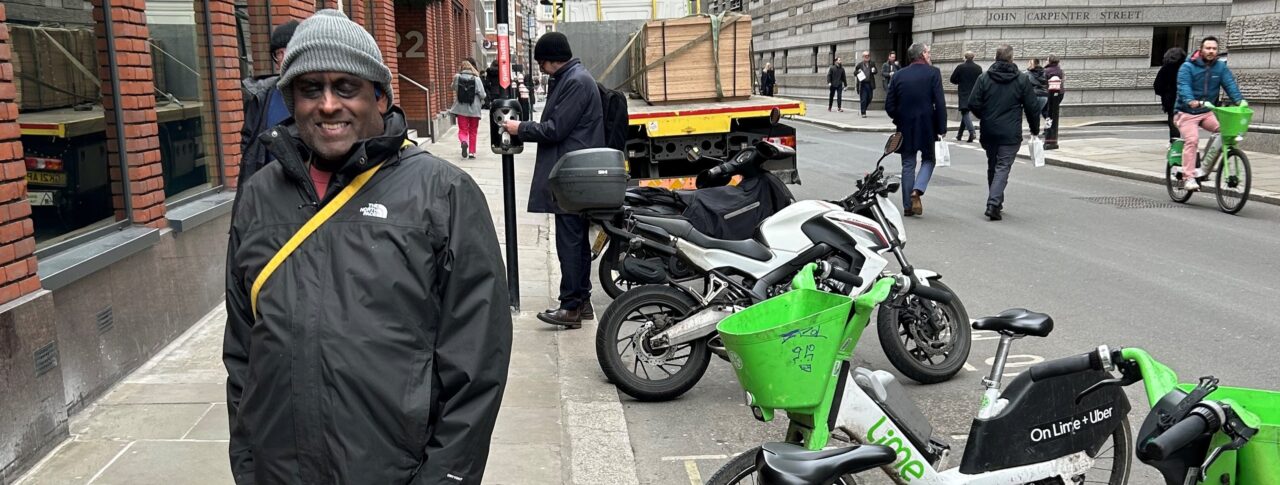
Creating Safer Streets: How London SLCs Are Tackling the E‑bike Challenge
London Sight Loss Council volunteers are working to ensure that blind and partially sighted people can move around the city safely and confidently. Their E‑bike Charter brings together operators, councils, and people with lived experience. The aim is to tackle the increasing impact of abandoned or badly parked e‑bikes on everyday independence.
This article was written by Haren, a volunteer with South West London Sight Loss Council. After a year of strong progress, Haren reflects on what has been achieved, and the steps ahead for 2026.
Why e-bikes?
E-bikes have soared in popularity in recent years, with London now the world’s largest rental market, making millions of journeys each year.
This growth has created real challenges, with abandoned or badly parked bikes blocking pavements and creating hazards. Surveys consistently show this is one of the top sources of anxiety in daily life for blind and partially sighted people.
In London, local authorities often cite a lack of regulation as a reason for limited action, but we did not believe this should be an excuse for inaction. That is why we launched the E-bike Charter – to reduce the impact of e-bikes on the safety and independence of blind and partially sighted people.
What the Charter aims to achieve
The Charter sets out six key actions to improve the experience of e-bikes from a BPS pedestrian’s perspective. These include moving parking off pavements, mandatory on-road bays, and improving access to operator data to increase accountability.
What we achieved in 2025
We have made strong progress with e-bike operators. Forest and Voi signed the Charter, joining Lime, and Bolt has agreed to sign in spring 2026 – making a full sweep of the capital’s operators.
Our work with operators included running simulated ‘sim-specs’ walks with both Lime and Forest. These helped them understand, first-hand, how poorly parked e-bikes impact BPS pedestrians.
We also worked with Lime and Voi on in-app messaging to encourage users to park responsibly and avoid blocking pavements.
Alongside this, we used the Charter to build relationships with key stakeholders, including Transport for London, London Councils, and several London boroughs. These conversations have helped create a shared commitment to making e-bikes safer for blind and partially sighted pedestrians.
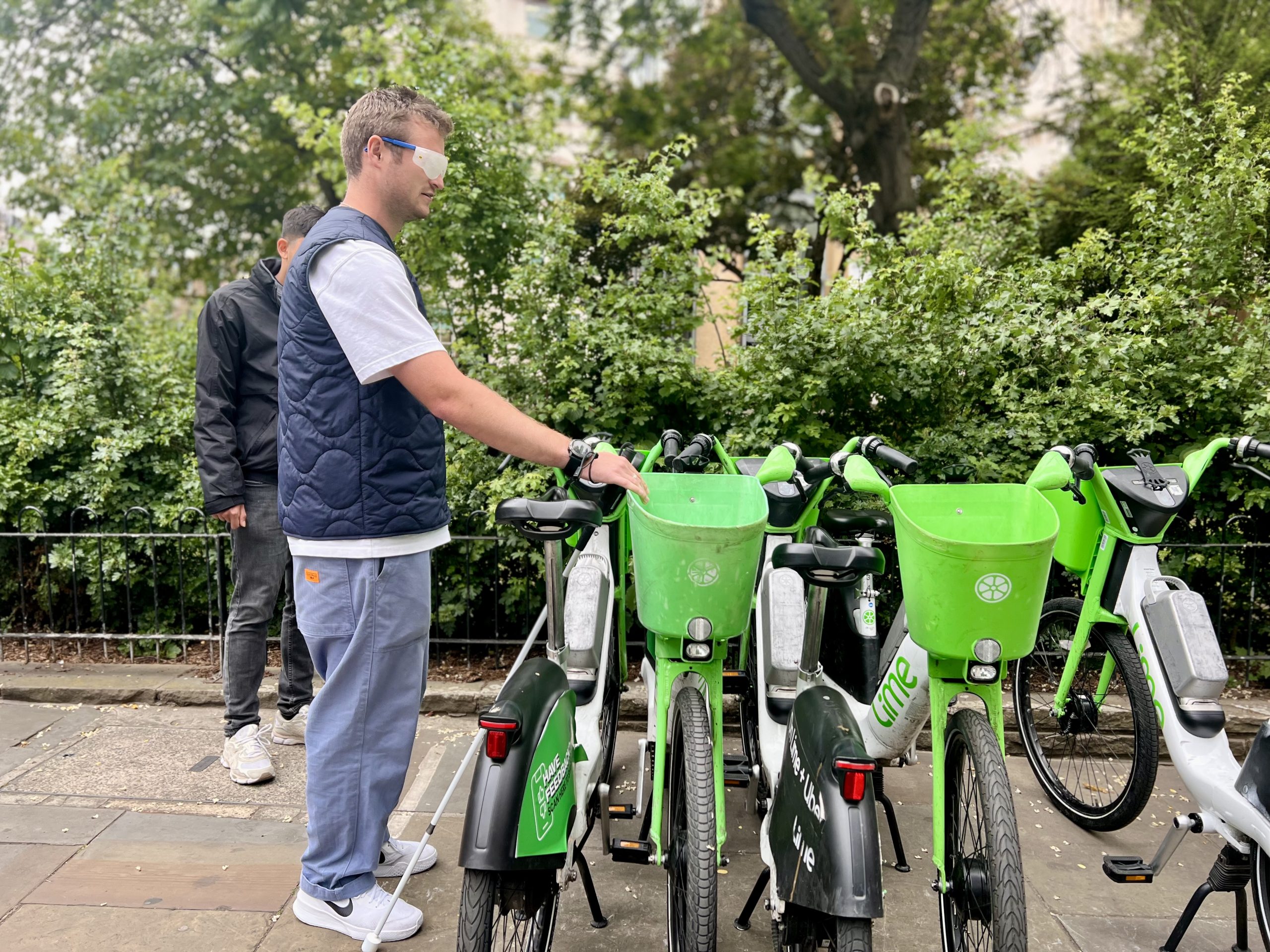
Hal Stevenson, Director of Policy for UK and Ireland at Lime, tries navigating a bike bay while wearing sim-specs
The importance of data
We have asked all signatories to report on key operational metrics, as this is the only way we can see how they are performing across London and hold them accountable.
Access to data is essential to making the Charter effective. It allows us to understand how operators are performing.
We welcome the progress made by Voi and Forest in sharing data. We now expect all Charter signatories to meet the same standard which will be key to our management of the Charter going forward.
Looking ahead to 2026
This year, we will continue to work with operators and authorities to introduce mandatory parking bays wherever e-bikes operate.
Encouragingly, more boroughs are already adopting this approach. With upcoming legislation, this could become consistent across London.
We also believe individual responsibility is a key part of the solution. We will continue working with stakeholders to promote better rider awareness and behaviour.”
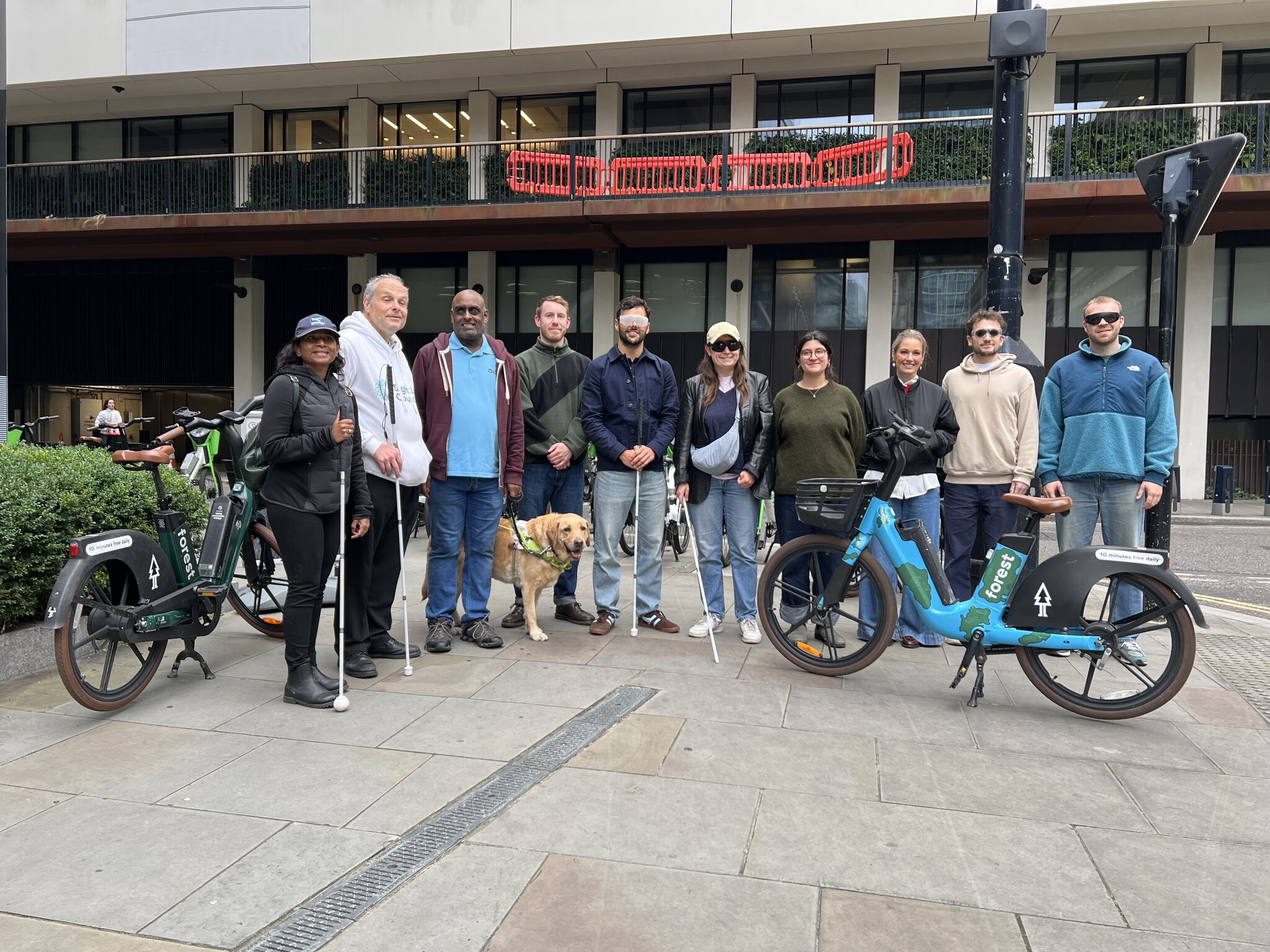
A group photo of London SLC members and staff from Forest, following last year’s sim-spec walk with the team
Together with operators, local authorities, and people with lived experience, we continue to shape a safer and more accessible future for blind and partially sighted people across London.
There is still more to do, but the progress of London SLCs so far shows what can be achieved when we work together, with lived experience at the forefront.
National context
This work sits within a wider national policy shift. The UK Government is currently progressing the English Devolution and Community Empowerment Bill, which would introduce a licensing framework for on‑street micromobility schemes. This would initially cover shared cycle services such as rental e‑bikes. The proposed framework would give local transport authorities stronger powers over issues including parking management, data sharing, and enforcement. This should help create a more consistent approach across the country. For London, it could provide an important national foundation for the changes we are seeking through the E‑bike Charter.
Learn more about London SLCs E-Bike Charter
Access the E-Bike Charter here
Would you like to join London Sight Loss Councils?
We are currently recruiting blind and partially sighted volunteers across London. If you want to use your lived experience to help shape local services and influence change, get in touch.
Publication date: 26 March 2026